
Fillmore County Criminal Docket Searches
Minnesota Court Records Online, or MCRO is the public search layer. It serves Fillmore County District Court. Four tabs cover different Fillmore questions: Case Search, Document Search, Hearing Search, and Judgment Search. Criminal work calls for Case Search. Choose "Select Specific County Court Locations," then pick Fillmore. Set the Criminal category too, when doing so will not screen out the case you want. A complete case number usually beats a broad name search. So does a citation number, attorney name, or bar number. The official case-search reference explains the controls and makes the same point.
Exact spelling is the default for a Fillmore name search. Wildcards work only at the end of at least two characters. Sounds Like is a separate option. You cannot pair it with a wildcard. A filing-date range or a date of birth can narrow a common name. Fillmore searches cap out at 200 results. The Fillmore case number is usually the clearest route. Sort, print, or open the result through View Case Details. Use MCRO's Return to Search control, not the browser Back button.
- Open MCRO and accept its public-access terms before selecting the Fillmore Case Search route.
- Select Fillmore under specific county locations and choose the Fillmore Criminal category only when it is known.
- Enter a complete case number, citation number, attorney identifier, or a carefully spelled name.
- Open Fillmore Case Details and review the Register of Actions, hearings, charges, and any public documents separately.
- Use Fillmore Court Administration for a courthouse-terminal review, an older file, or a requested copy.
Note: MCRO is a public information tool, and its Fillmore screen results are not certified court records.
Fillmore Criminal Cases in District Court
Fillmore County has one local trial-court location for criminal filings. That is Fillmore County District Court. It sits in Minnesota's Third Judicial District. The official Third Judicial District directory places Fillmore within an eleven-county administrative district. No separate county criminal court or municipal trial-court docket portal exists in the official Fillmore materials. A city administrative citation is a different animal from a filed District Court citation. The city office can handle an administrative question. But it never replaces the criminal court docket.
The Third Judicial District page linked above lays out the district context behind any Fillmore County criminal docket search.
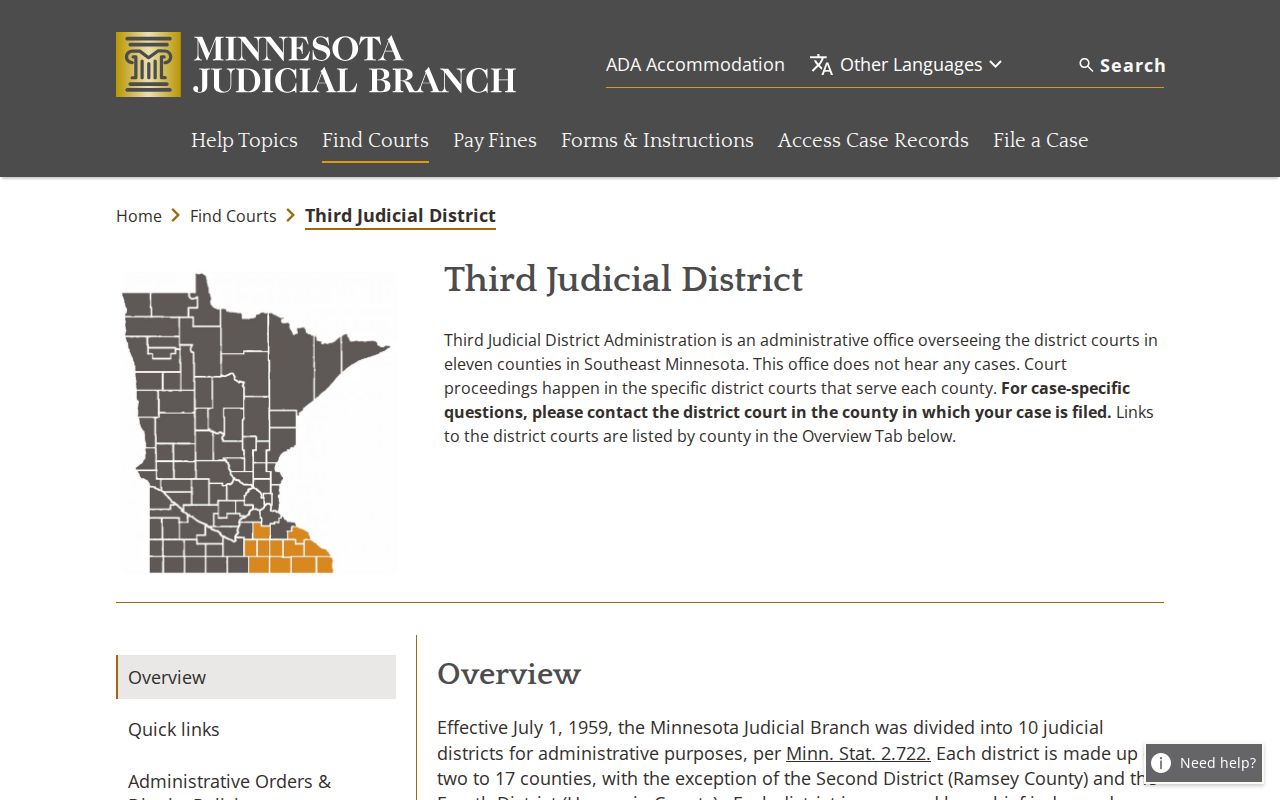
That structure matters. Fillmore felony, other criminal, traffic, civil, family, probate, and juvenile matters are all District Court categories, each with its own public-access rules. They are not records held in separate Fillmore County trial courts.
Criminal Dockets: What They Show
A Fillmore County criminal Case Details result brings several record blocks together. Case Information may list the case number and filing date. It may also list court location, judicial officer, status, citation number, flags, and related cases. Party and attorney entries help separate similarly named Fillmore cases. The Fillmore Register of Actions is the dated timeline. MCRO labels it Case Events. Each event may carry a description, a document index number, and a View Document control. That control appears only when an eligible public document exists.
Fillmore criminal information is not one flat list. Charges, interim conditions, and case assignment sit in separate blocks. So do hearings, dispositions, bond or bail activity, and financial information. A label may be unclear. The official MCRO Case Details field guide is the reference to consult. A Fillmore case status such as Open or Closed is administrative housekeeping. It does not replace the recorded disposition or sentencing entry.
| Case number | Fillmore criminal cases use county code 23 with category, year, and sequence elements, such as 23-CR-YY-NNN. |
|---|---|
| Case information | Fillmore filing date, venue, judicial officer, status, citation number, flags, and related cases can appear in the case header. |
| Charges | Fillmore current charges and amended-charge history may both appear, so the original complaint should not be treated as the final charge. |
| Hearings and events | Fillmore hearing dates and the Register of Actions show scheduled appearances, filings, orders, and other dated court activity. |
| Outcome blocks | Fillmore disposition, sentencing, bond or bail activity, fines, fees, payments, credits, and balances are distinct fields. |
Fillmore Criminal Citation Search Fallback
A missing Fillmore name result does not settle the question. MCRO issues a warning. A pending criminal, traffic, or petty-misdemeanor case with no conviction may not return in a defendant-name search. The same gap can affect dismissed or continued-for-dismissal counts. So for a Fillmore County case that will not appear by name, try other routes. Use the full case number or the citation number. The attorney name or complete bar number works too. Then adjust spelling with Sounds Like or a permitted trailing wildcard. Do not trust a close match.
If that fails, use the Fillmore courthouse public-access terminal or call Fillmore Court Administration. The case may be older than the remotely available documents. It may be subject to a rule-based restriction. Or it may be filed somewhere other than where you first looked. Fillmore County posts no separate public criminal-docket email, drop box, or county-built online criminal calendar. The statewide search plus the local court routes form the documented fallback chain.
Criminal Case Stages on the Docket
The Fillmore County Register of Actions gives each public stage its own date. There is no single narrative. A Fillmore case may open with filing and an initial appearance. Arraignment, pretrial or omnibus activity, a plea or trial setting, a disposition, and sentencing can follow. Motions, bail entries, probation reviews, restitution activity, dismissals, and later orders may also show up. They must be public and indexed. The sequence varies from case to case. Treat it as a map for reading events, not a promise that every case contains each one.
Docket flow: Filing → Arraignment → Pretrial → Plea or Trial → Disposition → Sentencing.
A reset does not erase what came before it. The earlier Fillmore hearing stays in the history. So read Fillmore events in date order, then set the newest hearing entry beside the local calendar. Notice that a plea, a disposition, and a sentence each get their own line. A recorded plea alone is not the final disposition. A balance owed tells you about money, not about how the case came out.
Fillmore Criminal Charges and Warrants
Treat Fillmore charges as their own block. A Fillmore County criminal docket can carry a current charge. It may also carry the amended-charge history behind it. So the initial Fillmore charge event may not match the charge on a later sentencing entry. That gap is normal. Compare the charge block, the Register of Actions, sentencing, and any final entry before assuming the earliest allegation was the court's last action. Financial entries deserve the same care. Fines, fees, credits, and balances sit apart from bond or bail activity on the docket. The Minnesota Judicial Branch's district-court criminal-charge material shows the charge categories and data behind this Fillmore criminal-charge context.
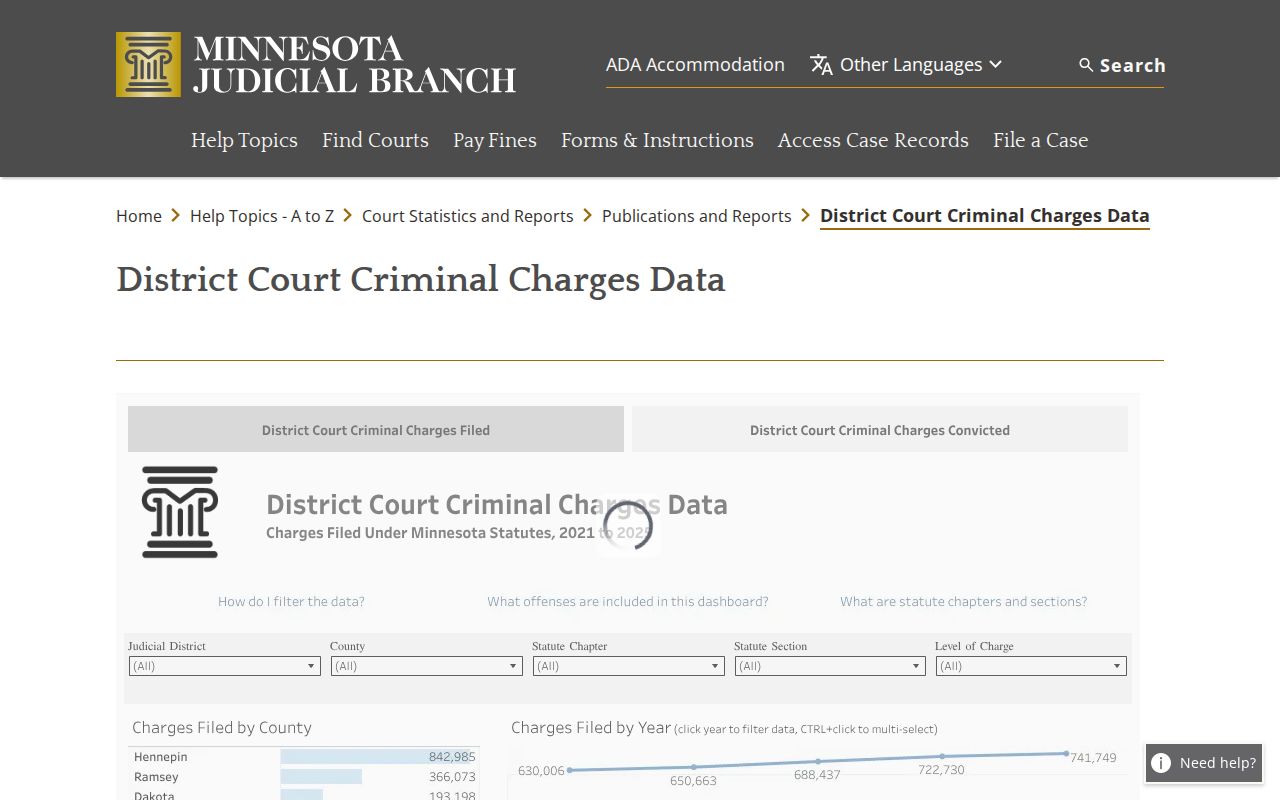
A warrant flag needs its own context check. MCRO can attach a flag at the party level or the case level. A party-level flag may belong to a different case entirely. So look at where MCRO displays it. Check the case it is attached to before treating it as proof of a warrant in this Fillmore County matter.
Fillmore County Criminal Docket Courts
For District Court criminal dockets and paper files, Fillmore County Court Administration is the local contact. It also handles calendar questions, public-terminal access, and copy or certification routing. The counter sits in the Fillmore County Courthouse. The address is 101 Fillmore Street E., Preston, Minnesota 55965. Call 507-765-6021 for the main line. The official Fillmore court page names the courthouse and its jurisdiction. Bring a docket question here. Do not take it to the county attorney. Court Administration is the neutral court-records contact.
Fillmore Court Administration
Fillmore County Courthouse
101 Fillmore Street E.
Preston, MN 55965
507-765-6021
The courthouse terminal in Fillmore generally offers the fullest electronic District Court access. Need a document instead? Use the statewide Copy Request Form or mail a written request to Fillmore Court Administration. Include the case number if you have it. Otherwise give enough party, county, year, and case-category detail to locate the file. One caution: eFS handles filing and service, not public docket viewing.
Fillmore Criminal Hearing Labels
Fillmore Policy 525, effective February 3, 2025, sets default appearance labels for adult criminal matters. A judge can deviate. The local Policy 525 table covers settlement conference, plea hearing, contested and default omnibus, evidentiary hearing, pretrial, sentencing, court trial, jury trial, Rule 5 first appearance, arraignment, bail, Rule 8 initial appearance, probation-violation admit or deny, review, motion, and other listed settings. Keep one thing straight. A label names the type of appearance, never its result.
- Rule 5 first appearance
- An early adult-criminal appearance named in Fillmore’s local default-appearance table.
- Rule 8 initial appearance
- A separate initial-appearance label in the same local criminal setting list.
- Omnibus hearing
- A criminal pretrial setting; Fillmore policy distinguishes contested and default omnibus hearings.
- Probation-violation admit or deny
- A listed setting where the response to an alleged probation violation is addressed.
For a current Fillmore time and place, check MCRO's Hearings block and the Fillmore daily calendar. Scheduled public hearings show up there. But the calendar is not the whole Fillmore case register.
Access Rules for Criminal Dockets
Access works in layers in Fillmore County. A Fillmore Register of Actions event can appear in MCRO. Its document image may stay off-limits remotely. The courthouse public terminal or counter may open a different route. A certified copy takes a request to Court Administration. And a complaint, warrant, plea petition, sentencing order, probation report, or exhibit is not a guaranteed download. Its event may sit on the docket anyway. Electronic exhibits need express judicial approval before the public can reach them.
The restrictions also vary by category. Juvenile matters never surface as ordinary adult criminal search results. Sealed or expunged records do not either. A Fillmore record can go missing. Ask Fillmore Court Administration which rule, sealing order, privacy category, or access channel applies. An unavailable online document does not mean no case exists. An older search result does not prove current access either.
Key Minnesota access rules:
Rules of Public Access, Rule 4 makes court records generally public subject to stated exceptions and court rules.
Rules of Public Access, Rule 8 explains why a public record may be available locally but not through remote electronic access.
Minnesota Statutes section 260B.163 addresses juvenile-hearing privacy and limited public exceptions.
Minnesota Statutes section 609A.01 is the statutory starting point for expungement and sealing access questions.
Fillmore Criminal Documents and Copies
The Fillmore docket timeline and the court file overlap. They are not the same thing. MCRO's View Document link shows up only for an eligible public document. The Register of Actions can still record the event itself without the image. For older material, a restricted file, or an official copy, use the documented Fillmore County route. It runs through the courthouse terminal or counter, Court Administration by phone, or a mail request on the statewide form. Plain copies are informational as a rule. Certification is a separate request to the court that keeps the record.
Supply the Fillmore case number, document description, and event or document-index information whenever you can. The public system may show a filing date, an order event, or a hearing. The full image may still be held back. That boundary is normal under Minnesota's access rules. Read a Fillmore County criminal docket with its source, date, and access status in mind.
Note: MCRO may not display a requested criminal document. Fillmore Court Administration can identify the available Fillmore inspection or copy route.